


Every Capacitor-vs-Flutter-vs-React-Native comparison online runs the same feature checklist: performance, hot reload, platform coverage. That's the wrong lens if you're not starting from zero. If you run an Angular or React team already shipping a web product, the real question is narrower: how much of what you have do you keep, what does the gap cost to hire for, and how far does the plugin ecosystem get you before you're writing native code yourself.
Capacitor: your app, inside a native shell
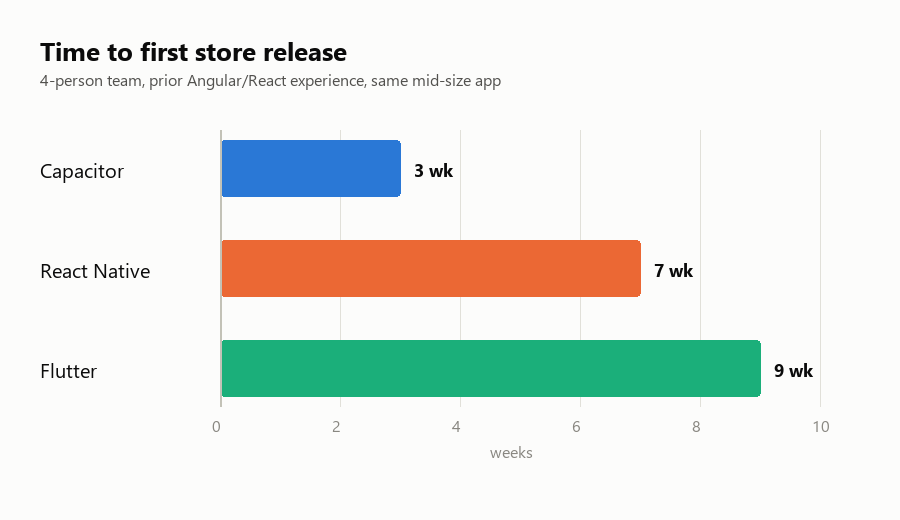
Capacitor wraps the web app you already have -- Angular, React, Vue, doesn't matter -- in a native shell with a bridge to native APIs. You keep the overwhelming majority of your codebase: routing, state management, your component library, your test suite, your CI pipeline. A developer who already knows your Angular app is productive on the mobile build in days, not weeks, because it's still TypeScript, still the same mental model, still debuggable in Chrome DevTools against a live device.
The tradeoff is a performance ceiling and more manual work to get native look-and-feel right -- platform-specific transitions, haptics timing, gesture-heavy interactions all take deliberate effort rather than coming for free. For a content-heavy or CRUD-heavy app, that ceiling rarely matters. For something closer to a game or a drawing app, it will.
Flutter: a different language, a different renderer, a different hire
Flutter draws every pixel itself through its own rendering engine, which is exactly why it gets near-native performance and pixel-identical output across iOS and Android. None of that comes from your web codebase, though -- Dart and Flutter's widget tree are a genuine rewrite, not a port. Your Angular developers start from zero on both the language and the UI model.
Hiring is the part teams underestimate. The Flutter talent pool is real but noticeably smaller than the JS/TS pool, salaries for strong Flutter engineers run at a premium in a tight market, and even a capable existing developer needs real ramp-up time before they're shipping production code confidently. The plugin ecosystem on pub.dev is solid for mainstream needs -- camera, push notifications, biometrics -- but niche integrations are more likely to be community-maintained with inconsistent upkeep, so it's worth checking a plugin's last-publish date before committing to it.
React Native: closer to home, but still not your app
JSX, hooks, and a lot of the React mental model transfer directly, which makes React Native the obvious middle ground for a React-based web team. It's a worse fit for an Angular shop specifically, who would be learning React's component model at the same time as the mobile-specific parts -- navigation, native modules, platform quirks.
The New Architecture (Fabric plus TurboModules, default and mature by now) has mostly closed the old bridge-overhead performance gap that used to be React Native's weak point. The plugin ecosystem is enormous -- it's npm, after all -- but version skew between RN core releases and community-maintained native modules is a real, recurring maintenance tax. Staying inside Expo's managed workflow smooths a lot of this out, at the cost of occasionally hitting an Expo constraint you have to work around.
time to first release, for an Angular team
the actual decision
| Framework | Code reuse | Hiring, for an Angular/React shop | Plugin maturity | Best fit |
|---|---|---|---|---|
| Capacitor | ~90%, same codebase | Reuses the team you have | Mature web ecosystem plus capacitor-community plugins; drop to native when needed | Ship fast, content/CRUD-heavy app, moderate native need |
| React Native | Partial -- React patterns carry over | Natural for React teams, a real ramp for Angular teams | Huge but version-skew prone | React-first teams wanting closer-to-native without a full rewrite |
| Flutter | ~0% -- full rewrite | New language and model, smaller and pricier pool | Strong core, thinner for niche integrations | Heavy custom UI/animation, long-horizon native-grade product worth the investment |
what actually tips teams toward Capacitor
It's rarely a single technical advantage -- it's that the decision stops being a hiring decision and a retraining decision and goes back to being a product decision. When the people who build your web app can build your mobile app without becoming different engineers first, you ship the first version faster and keep shipping at the same pace afterward. That's worth more, for most teams, than Flutter's rendering ceiling or React Native's slightly-closer-to-native feel.